Blog
7 Red Flags Before You Sell Your Gift Card in Nigeria
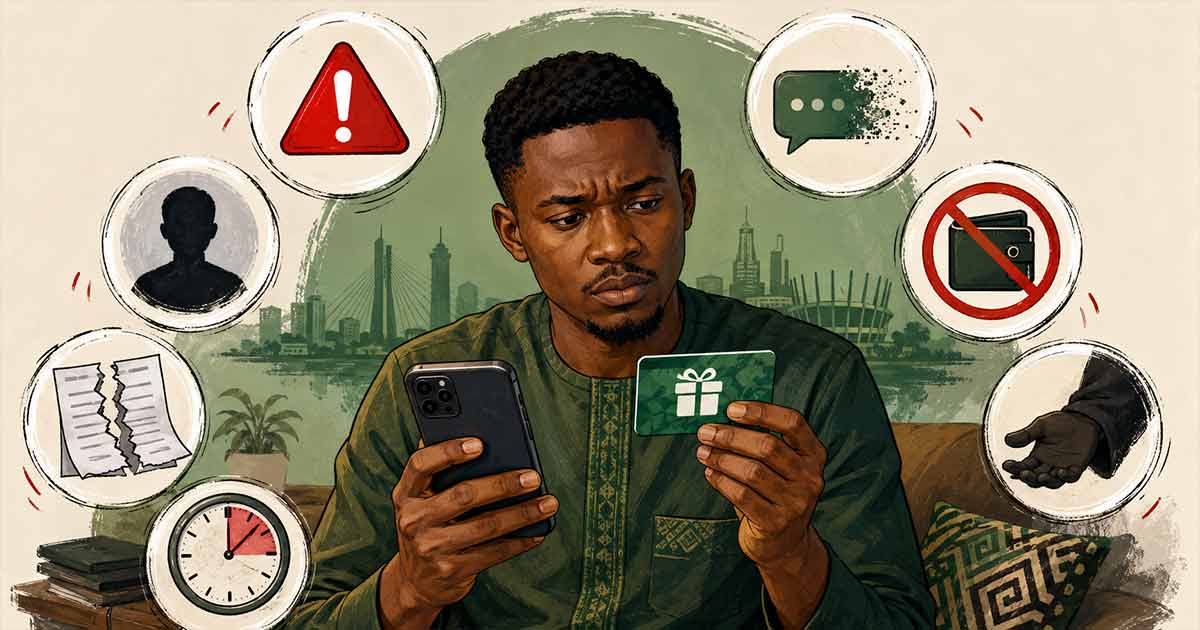
7 Red Flags Before You Sell Your Gift Card in Nigeria
Nigeria's gift card market moves fast — and so do the scammers inside it. Every week, people lose real money because they missed warning signs that, in hindsight, were obvious. The problem isn't that the red flags are hidden. It's that urgency, greed, and unfamiliarity with how legitimate platforms operate make it easy to overlook them.
This guide is a pre-trade checklist. Before you hand over any gift card code, run through these 7 red flags. If you spot even one, stop and reconsider.
Red Flag #1: No Clear Rate Display
Legitimate gift card platforms in Nigeria display their rates publicly — before you log in, before you submit a card, before you do anything. You should be able to see exactly what you'll get for a US iTunes card or a Steam card without giving up any information first.
If a platform or buyer says "send the card and I'll tell you the rate" or "DM me for today's rate," that's a problem. They're either making up the rate after seeing your card, or they're planning to lowball you once you've already committed.
What to do: Only trade on platforms where rates are visible upfront, broken down by card type, region, and denomination.
Red Flag #2: They Ask for the Card Code Before Confirming the Rate
This is the most common setup for gift card theft in Nigeria. The sequence goes like this: you ask about the rate, they say they need to "verify the card first," you send the code, and then either the rate drops dramatically or they disappear entirely.
Here's the reality: a legitimate platform can tell you the rate for a US Apple gift card without seeing your specific card. The rate is based on card type, not on your individual card's serial number. Anyone who needs your code before quoting a rate is not operating legitimately.
What to do: Get a confirmed rate in writing (screenshot it) before submitting any code. If they won't give you a rate first, walk away.
Red Flag #3: No Real Customer Support
Scam operations don't invest in customer support because they don't plan to be around long enough to need it. If a platform's only contact method is a WhatsApp number or a Telegram handle — with no email, no live chat, no phone number, and no verifiable business address — that's a serious warning sign.
Real platforms have support infrastructure because they handle disputes, failed transactions, and verification issues daily. They need to be reachable.
What to do: Before trading, test the support channel. Send a question and see how quickly and professionally they respond. Check if the platform has a Google Play or App Store listing with real reviews.
Red Flag #4: Telegram-Only Contact
Telegram is the preferred tool of Nigerian gift card scammers. It's anonymous, messages can be deleted, accounts can be created instantly, and there's no identity verification. This doesn't mean everyone on Telegram is a scammer — but it does mean that a buyer or platform that operates exclusively through Telegram, with no other verifiable presence, has chosen a channel specifically designed to avoid accountability.
Watch for: Telegram groups with "verified trader" claims, pinned testimonials from accounts with no history, and admins who pressure you to trade quickly before "rates change."
What to do: Use platforms with a real web presence, app store listing, and support channels outside of Telegram. If someone insists on Telegram-only, treat it as a red flag regardless of how many "testimonials" they show you.
Red Flag #5: Fake Payment Alerts
This scam is devastatingly effective because it exploits trust in familiar-looking bank notifications. The buyer sends you a screenshot of a bank transfer — it looks exactly like a real GTBank, Access Bank, or Opay alert. You see the amount, your account number, and a transaction reference. You hand over the card code. The money never arrives.
The screenshot was either photoshopped or generated using one of several fake alert apps that are widely available in Nigeria. The transaction reference is fake. The money was never sent.
What to do: Never release a card code based on a screenshot. Wait until the money actually reflects in your account — check your balance directly in your banking app. If a buyer pressures you to release the code before you've confirmed receipt, refuse.
Red Flag #6: No Review History or Verifiable Track Record
A platform or trader with no verifiable history is a platform or trader you can't trust. "Testimonials" on a website or pinned messages in a Telegram group prove nothing — they can be fabricated in minutes.
What actually matters: reviews on independent platforms (Google Play Store, Apple App Store, Trustpilot), mentions in Nigerian fintech communities, and a track record that predates your interaction with them.
New platforms aren't automatically scams, but they deserve extra scrutiny. If a platform launched last month and is already offering the best rates in the market, ask yourself why an established, legitimate business would undercut everyone else immediately.
What to do: Search the platform name + "scam" or "review" on Google and Twitter/X before trading. Check the app store rating and read the negative reviews specifically — they reveal patterns.
Red Flag #7: Pressure Tactics and Artificial Urgency
Scammers use urgency to short-circuit your judgment. Common pressure tactics in Nigeria's gift card market include:
- "This rate expires in 5 minutes" — countdown timers designed to make you skip verification.
- "I have 10 other buyers waiting" — false scarcity to make you feel you'll miss out.
- "Just send the code first, I'll pay immediately" — bypassing the rate-confirmation step.
- "Why are you wasting time? Other people trust me" — social pressure to override your caution.
- "If you don't send now, I'll give the rate to someone else" — manufactured competition.
Legitimate platforms don't pressure you. Their rates are stable enough that a 5-minute delay doesn't matter. They want you to be comfortable because they're building a long-term business, not executing a one-time theft.
What to do: Treat any urgency as a signal to slow down, not speed up. If someone is pressuring you, that pressure itself is the red flag.
The Pre-Trade Checklist
Before submitting any gift card code, confirm:
- Rate is displayed publicly and confirmed before code submission.
- Platform has real customer support (not just Telegram).
- Platform has verifiable reviews on independent platforms.
- Payment method is bank transfer or verified wallet — not airtime, crypto, or "mobile money" from an unknown number.
- You will wait for payment to reflect before releasing the code.
- No one is pressuring you to act faster than you're comfortable with.
If all six boxes are checked, you're in a reasonable position to trade. If any are missing, reconsider.
What to Do If You've Already Been Scammed
If you've already lost a card to a scammer:
- Document everything immediately — screenshots, chat logs, transaction references.
- Report to the EFCC via their online portal (efcc.gov.ng).
- If a fake bank transfer was involved, report to your bank's fraud line.
- Share the scammer's details (platform name, Telegram handle, phone number) in Nigerian fintech communities to warn others.
Recovery is unlikely, but reporting creates a paper trail that helps authorities identify repeat offenders.
Final Word
The gift card market in Nigeria is real and legitimate — but it attracts bad actors precisely because it's fast-moving and largely unregulated. The seven red flags in this guide aren't theoretical. They're patterns pulled from real scams that have cost real people real money.
Slow down. Verify. Don't let urgency or a slightly better rate push you into skipping steps. The card is yours until you hand over the code — and once that code is gone, so is your leverage.