Blog
Amazon Gift Card Scams in Nigeria: How to Spot, Avoid and Report Them
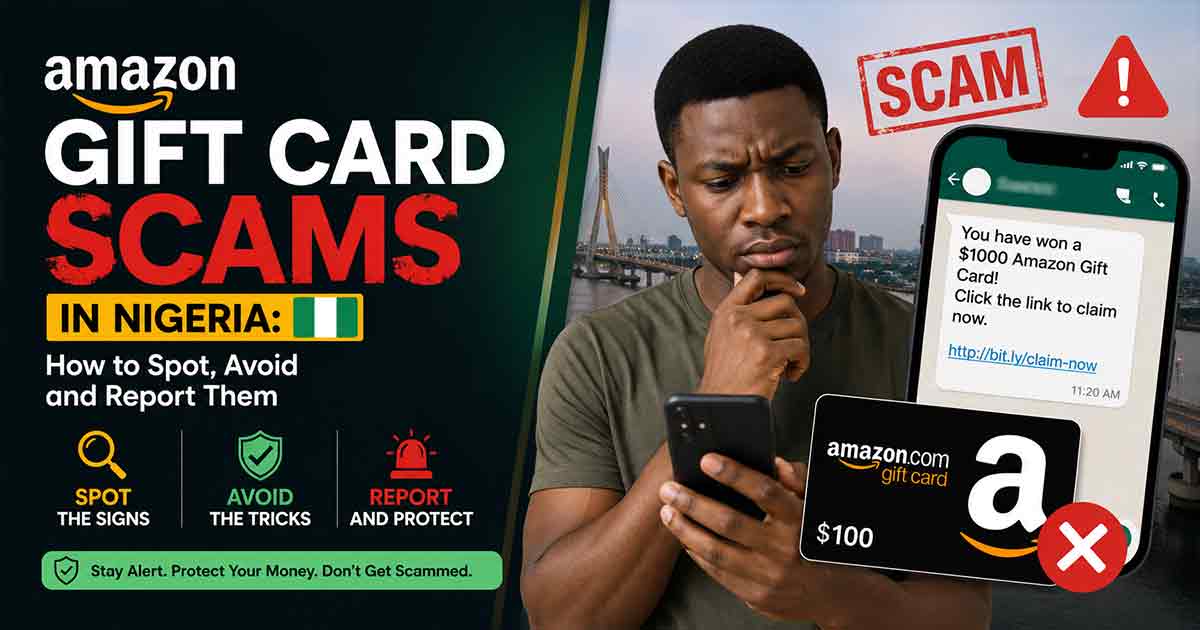
Amazon Gift Card Scams in Nigeria: How to Spot, Avoid and Report Them
Gift cards have become one of the most popular tools for scammers in Nigeria — and Amazon gift cards sit at the top of that list. Whether you received a suspicious WhatsApp message, a "lottery win" email, or a call from someone claiming to be Amazon support, this guide will help you understand exactly what's happening and what to do about it.
We'll cover every major scam type, the red flags that give them away, and — critically — how to report gift card fraud to Nigerian authorities including the EFCC and FCCPC.
Why Scammers Love Gift Cards
Gift cards are the preferred payment method for fraudsters for three reasons:
- Irreversible — once a gift card code is shared, the money is gone. Unlike bank transfers, there's no chargeback mechanism.
- Anonymous — gift card codes don't carry the buyer's identity, making them hard to trace.
- Globally liquid — Amazon gift cards can be resold or used anywhere in the world within minutes.
No legitimate company, government agency, or individual will ever ask you to pay for anything using a gift card. That single rule eliminates 99% of gift card scams.
The Most Common Amazon Gift Card Scams in Nigeria
1. Phishing Emails and Fake Amazon Websites
You receive an email that looks exactly like it came from Amazon — same logo, same fonts, same layout. It tells you there's a problem with your account, a pending refund, or an unclaimed reward. The link takes you to a fake Amazon site that harvests your login credentials or asks you to "verify" your account by purchasing gift cards.
Red flags:
- The sender email is not @amazon.com (e.g., [email protected] or amazon.ng-verify.com)
- The link URL doesn't start with amazon.com
- The email creates urgency: "Your account will be suspended in 24 hours"
- It asks you to buy gift cards and send the codes
2. Lottery and Prize Scams
A message arrives — via email, SMS, or WhatsApp — congratulating you on winning an Amazon prize draw, a cash reward, or a free iPhone. To "claim your prize," you must first pay a processing fee or tax using Amazon gift cards.
Amazon does not run unsolicited prize draws. If you didn't enter a competition, you didn't win one. Any prize that requires upfront payment is a scam, full stop.
3. Tech Support Scams
Your screen suddenly shows a pop-up warning that your computer has a virus and you must call a number immediately. The "technician" who answers claims to be from Amazon, Microsoft, or your internet provider. After "fixing" the problem remotely, they demand payment via Amazon gift cards.
Real tech support teams never demand gift card payment. Real security alerts don't come with phone numbers to call.
4. Romance Scams
You meet someone online — on Facebook, Instagram, or a dating app. After weeks of building trust, they hit a crisis: a medical emergency, a business deal gone wrong, a flight they can't afford. They ask you to send Amazon gift card codes because "it's faster than a bank transfer."
This is one of the most emotionally damaging scam types in Nigeria. The person you've been talking to is almost certainly not who they claim to be. The relationship was engineered specifically to reach this moment.
5. Family Emergency Scams
You receive a call or message from someone claiming to be a relative in trouble — arrested abroad, in a hospital, stranded at an airport. They need money urgently and ask you to buy Amazon gift cards and send the codes. Sometimes the scammer impersonates the relative's voice using AI voice cloning.
Before sending anything, hang up and call the relative directly on a number you already have saved. Do not use any number provided by the caller.
6. WhatsApp and Telegram Gift Card Buyer Scams
This one is specific to Nigeria's gift card trading community. A "buyer" contacts you on WhatsApp or Telegram, offers a rate above market, and asks you to send the card codes first before payment. Once you send the codes, they block you.
Always use verified, registered platforms for gift card trading. Never trade with individuals on messaging apps, regardless of how professional they appear.
7. Fake Job Offer Scams
You apply for a remote job and receive an offer letter. During "onboarding," you're asked to purchase Amazon gift cards as part of a "test transaction" or to set up your work account. The job doesn't exist. The company doesn't exist.
No legitimate employer asks new hires to buy gift cards. Ever.
How to Protect Yourself
The Golden Rule
No legitimate entity — company, government, employer, or individual — will ever ask you to pay using gift card codes. If someone asks for gift card codes as payment, it is a scam. End the conversation immediately.
Verify Before You Act
- If you receive a suspicious Amazon email, go directly to amazon.com in a new browser tab — don't click any links in the email
- If someone calls claiming to be Amazon support, hang up and call Amazon's official customer service number
- If a "relative" contacts you in an emergency, call them back on their known number
Slow Down
Scammers create urgency on purpose. "You must act in the next hour or lose your prize." "Your account will be closed today." The pressure is designed to stop you from thinking clearly. Any situation that demands immediate gift card payment is a scam.
Protect Your Card Codes
Treat gift card codes like cash. Once you share a code, the money is gone. Never photograph your card and send the image to anyone you don't know personally.
How to Report Amazon Gift Card Scams in Nigeria
If you've been targeted or victimized by a gift card scam, you have real reporting options in Nigeria. Reporting matters — it helps authorities track patterns and potentially recover funds in some cases.
1. Economic and Financial Crimes Commission (EFCC)
The EFCC is Nigeria's primary agency for financial fraud. You can report gift card scams through:
- Online: efcc.gov.ng/report-a-case
- Email: [email protected]
- Hotline: 0800-326-5255 (toll-free)
- Walk-in: Any EFCC zonal office in your state
Provide as much detail as possible: screenshots of conversations, phone numbers used, any account details the scammer shared, and the gift card codes if you still have them.
2. Federal Competition and Consumer Protection Commission (FCCPC)
The FCCPC handles consumer protection complaints, including digital fraud. Report at:
- Online: fccpc.gov.ng
- Email: [email protected]
3. Nigeria Police Force Cybercrime Unit
The NPF has a dedicated cybercrime unit. You can report at any state command or through the Force headquarters in Abuja.
4. Report to Amazon Directly
Amazon has a dedicated fraud reporting page at amazon.com. Reporting helps Amazon flag and disable compromised gift card codes faster.
5. Report the Phone Number or Account
- On WhatsApp: Open the chat → tap the contact name → scroll down → "Report Contact"
- On Telegram: Open the chat → tap the three dots → "Report"
- On Facebook/Instagram: Use the "Report" option on the profile or message
What to Do If You've Already Been Scammed
- Stop all contact with the scammer immediately
- Document everything — screenshots, phone numbers, account names, transaction records
- Report to EFCC as soon as possible — time matters for investigations
- Contact Amazon if the codes haven't been redeemed yet — in rare cases, Amazon can deactivate unused codes
- Warn your contacts — scammers often use compromised accounts to target the victim's friends and family next
Frequently Asked Questions
Can I get my money back after a gift card scam?
Recovery is difficult but not impossible. If the codes haven't been redeemed, Amazon may be able to deactivate them. If you paid by bank transfer to purchase the cards, contact your bank immediately. EFCC investigations have led to recoveries in some high-value cases.
Is it safe to sell Amazon gift cards in Nigeria?
Yes — selling through registered, verified platforms is safe. The risk comes from trading with unknown individuals on WhatsApp or Telegram. Stick to platforms with a public track record and customer support.
How do I know if an Amazon email is real?
Check the sender's email address carefully. Amazon only sends emails from @amazon.com domains. If the domain is anything else, it's fake. When in doubt, log into your Amazon account directly through your browser — don't click email links.
Stay Alert, Stay Safe
Gift card scams in Nigeria are sophisticated and constantly evolving. The tactics change, but the core mechanism doesn't: they create urgency, build trust or fear, and ask for gift card codes as payment.
The best protection is simple awareness. Share this guide with family members — especially older relatives who may be less familiar with these tactics. The more people who recognize these patterns, the harder it becomes for scammers to operate.