Blog
Bank App or Fintech App: Which Should Nigerians Use for Daily Transfers?
Research brief
The reference article reports that Nigerian banks processed very large mobile transaction volumes in 2025 and argues that banks are closing the reliability gap with fintech apps. The key search intent is practical: Nigerians want to know which app is safer and more reliable for everyday transfers. This draft turns the market update into a user-focused decision guide, with comparison points, use cases, safety checks, and transfer-failure prevention tips.
The Short Answer
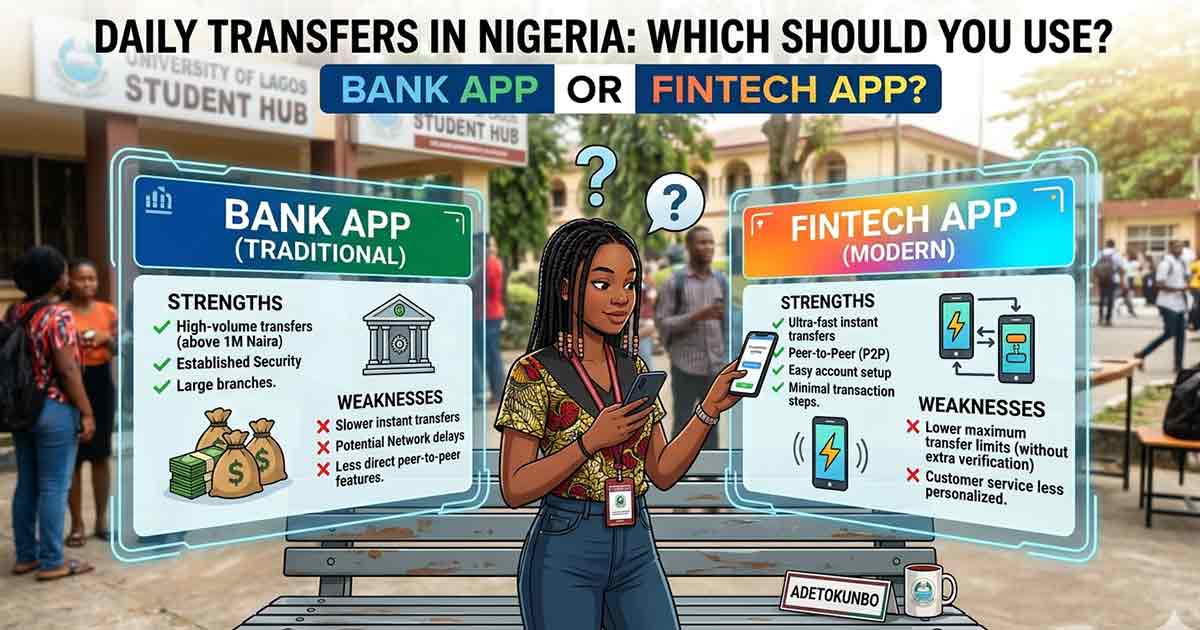
Most Nigerians should not choose only one side. A bank app and a fintech app can serve different purposes. Use your main bank app for salary, larger transfers, official records, and account history. Use a trusted fintech app for fast everyday transfers, small bill payments, airtime, data, and backup when your bank app is slow.
The better question is not "bank app or fintech app?" It is: "Which app should I use for this exact transaction?" A ₦2,000 airtime top-up, a rent transfer, a business payment, and an urgent POS refund do not carry the same risk.
Why Fintech Apps Became Popular in Nigeria
Nigerians did not move to fintech apps by accident. Many users adopted apps like OPay, PalmPay, Moniepoint, Kuda, and similar platforms because they wanted speed, simple interfaces, lower fees, and fewer failed transfer problems.
During periods when cash was scarce and bank channels were unreliable, many people needed apps that worked quickly for transport, food, POS payments, airtime, data, and small business collections. Fintech apps positioned themselves as faster and easier for daily money movement.
For students, freelancers, traders, delivery riders, and small vendors, that speed matters. If a customer pays for food, hair, thrift clothes, or gadget accessories, the seller wants confirmation immediately. Waiting for a bank app to load can cost sales.
Why Bank Apps Are Still Important
Traditional banks still hold an important place in Nigerian financial life. Many salaries, business accounts, loans, cards, fixed deposits, official statements, and large transfers still pass through banks. Banks also have a long operating history and are tied to formal financial records that many users need for work, travel, school, or business verification.
Recent reporting from Nigeria's digital payment market shows that major banks are investing heavily in mobile channels and processing huge transaction volumes. This suggests that the old gap between bank apps and fintech apps is getting smaller. Some bank apps are faster today than they were a few years ago, and many banks now understand that poor mobile reliability pushes customers away.
Still, improvement is not the same as perfection. Users should judge each app by real performance, not by brand name alone.
Bank App vs Fintech App: Key Differences
| Factor | Bank App | Fintech App |
|---|---|---|
| Best for | Salary, large transfers, statements, formal banking | Small transfers, bills, airtime, quick daily payments |
| Speed | Improving, but can vary by bank and network | Often fast for small everyday transactions |
| Fees | May include standard transfer and account charges | Often competitive, sometimes with free transfer offers |
| Support | Branches, call centres, email, in-app support | Mostly in-app chat, call centre, social support, agent networks |
| Records | Strong for official statements and long-term account history | Good for app history, but may not replace bank statements for formal needs |
| Convenience | Useful if your main account is already there | Useful for fast payments and everyday spending |
When to Use a Bank App
A bank app is usually better when the transaction needs stronger documentation or is tied to your main financial identity.
Use a bank app for:
- Receiving salary or formal business income.
- Paying rent, school fees, or other large bills.
- Moving money where a bank statement may be needed later.
- Managing debit cards, cheque-related records, loans, or fixed deposits.
- Sending money to institutions that require a traditional bank trail.
If the transfer is large, take screenshots, confirm account names carefully, and avoid rushing. It is better to spend one extra minute checking than to spend days chasing a reversal.
When to Use a Fintech App
A fintech app is often more convenient for quick, frequent, low-to-medium value payments. The interface is usually simpler, and many fintech apps are built around the daily habits of Nigerian users.
Use a fintech app for:
- Airtime, data, cable TV, and electricity payments.
- Small transfers to friends, vendors, riders, or POS agents.
- Separating spending money from your main savings account.
- Fast transfers during busy hours when your bank app is struggling.
- Receiving small customer payments if you run a side hustle.
However, do not keep all your money in one app because it feels convenient. Convenience should not replace risk management.
How to Reduce Failed Transfer Problems
Failed transfers are one of the biggest frustrations in Nigeria's payment system. Sometimes money leaves your account but does not arrive immediately. Sometimes the recipient gets value later. Sometimes reversal takes time.
Reduce the risk with these habits:
- Check the recipient name before sending.
- Avoid repeating the same transfer immediately if the first one is pending.
- Keep transaction receipts and reference numbers.
- Use stable internet before sending large payments.
- Do not rely on one app when you have an urgent payment.
- For business, confirm payment inside your own app before releasing goods.
If a transfer fails, contact support with the transaction reference, amount, date, recipient bank, and recipient account number. Emotional messages waste time. Clear details help support teams trace the payment faster.
Safety Checklist Before Trusting Any Payment App
Whether you use a bank app or fintech app, your safety habits matter. A trusted app can still be misused if your phone, PIN, or SIM is compromised.
- Use a strong app PIN that is not your birth year or phone digits.
- Turn on biometric login only if your phone is secure.
- Never share OTPs, card details, app passwords, or recovery codes.
- Lock your SIM with a SIM PIN if your phone supports it.
- Download apps only from official app stores.
- Be careful with fake customer care accounts on social media.
- Update your app regularly to get security fixes.
Scammers often pressure users by claiming an account will be blocked. Real support teams should not ask for your password, full card details, or OTP.
Which Is Better for Small Businesses?
Small businesses in Nigeria often need both. A fintech account can help with fast customer collections, POS-related payments, bills, and daily operational spending. A bank account can help with supplier payments, taxes, formal statements, and larger savings.
If you sell gift cards, fashion items, food, gadgets, or digital services, separate business money from personal spending. Even if you are not fully registered yet, use different wallets or accounts so you can see whether the business is actually profitable.
For customer payments, display one preferred account but keep a backup. If one channel is down, you can still collect money without delaying the sale.
Which Is Better for Students and Salary Earners?
Students may prefer fintech apps for daily spending because the apps are simple and quick. But students should still keep a bank account for school payments, family transfers, internship salaries, scholarship records, and future documentation.
Salary earners should be more careful. Do not move your full salary into a spending app on payday unless you have a budget. Keep fixed obligations such as rent, transport, savings, and family support separate before moving daily spending money into a fintech wallet.
A Practical Setup for Everyday Nigerians
A balanced setup can look like this:
- Main bank account: salary, large transfers, formal records, emergency funds.
- Fintech wallet: daily spending, airtime, data, small vendor payments.
- Backup account: a second channel for urgent transfers when one app is down.
- Savings pocket: money you do not touch for casual spending.
This setup reduces stress because no single app controls your entire money life. If your bank app fails, you have a fintech option. If your fintech wallet has issues, your bank account still holds your main records.
FAQ
Are fintech apps safer than bank apps in Nigeria?
Safety depends on the provider and your habits. Use regulated, trusted apps, protect your PIN and OTP, and avoid keeping all your money in one place.
Why do bank transfers fail in Nigeria?
Transfers can fail because of network issues, downtime, delayed bank switches, wrong details, or temporary system congestion. Always keep transaction references when reporting problems.
Should I use a fintech app for my salary?
You can receive income in a fintech account if it supports your needs, but a traditional bank account is still useful for formal statements, large transactions, and long-term records.
What should I do if money is debited but not received?
Do not repeat the transfer immediately. Save the receipt, wait for the pending window if shown, and contact support with the reference number, amount, date, and recipient details.
Final Verdict
Bank apps and fintech apps are no longer enemies in the daily life of Nigerian users. They are tools for different jobs. Bank apps are stronger for formal records, larger transactions, and main account management. Fintech apps are often better for quick everyday payments and backup convenience. The smartest approach is to use both carefully, keep records, protect your login details, and avoid depending on one payment channel for every financial need.