Blog
eSIM vs Virtual Number: Which One Do You Actually Need?
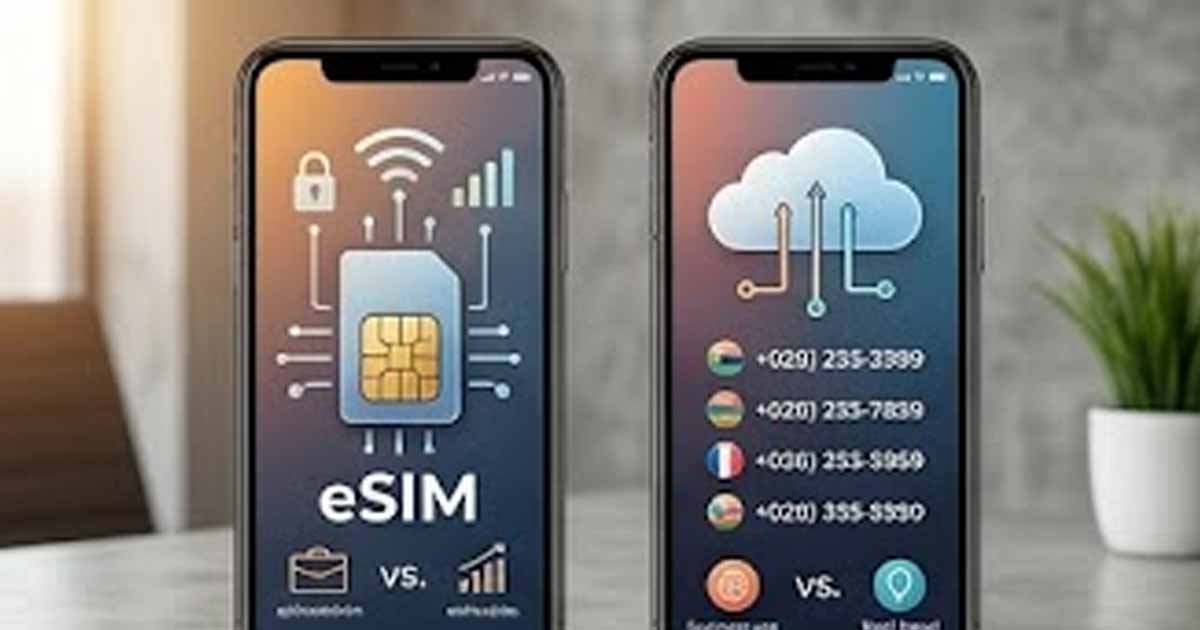
The Core Difference in One Sentence
An eSIM replaces your physical SIM card and gives you cellular connectivity (data, calls, SMS). A virtual number gives you a phone number that works over the internet (VoIP) without any SIM card at all. They solve completely different problems, even though both involve "not having a physical SIM."
What an eSIM Actually Is
An eSIM (embedded SIM) is a digital SIM built into your phone's hardware. It does everything a traditional SIM card does: connects to cellular networks, provides mobile data, and enables calls and SMS. The difference is purely physical. Instead of inserting a plastic card, you download a carrier profile onto the embedded chip.
What you get with an eSIM:
- Mobile data access on cellular networks
- A real phone number (on voice-enabled plans)
- SMS capability (on voice-enabled plans)
- The ability to switch carriers without swapping physical cards
- Dual-SIM capability (use your physical SIM and eSIM simultaneously)
What you do NOT get:
- Data-only eSIMs cannot make regular phone calls or send SMS (only internet-based calls via WhatsApp, FaceTime, etc.)
- Not all phones support eSIM (requires iPhone 11 or later, or recent Android flagships)
What a Virtual Number Actually Is
A virtual number is a phone number that exists entirely in software. It uses Voice over Internet Protocol (VoIP) to route calls and messages through the internet rather than cellular towers. You do not need a SIM card, a specific phone, or even a phone at all. Virtual numbers work on phones, tablets, laptops, and desktops.
What you get with a virtual number:
- A real phone number that others can call or text
- The ability to make and receive calls over the internet
- SMS capability (varies by provider)
- A local number in a country where you are not physically present
- Works on any internet-connected device
- Multiple numbers on one device without multiple SIMs
What you do NOT get:
- Mobile data or cellular connectivity
- Functionality without an internet connection
- A traditional carrier relationship
Side-by-Side Comparison
Here is how they stack up across the factors that matter most:
Connectivity
eSIM: Provides its own cellular data connection. Works independently of Wi-Fi.
Virtual Number: Requires an existing internet connection (Wi-Fi or mobile data from another source). Cannot provide its own data.
Calls and SMS
eSIM: Voice-enabled eSIMs make regular cellular calls. Data-only eSIMs only support internet-based calls (WhatsApp, FaceTime).
Virtual Number: All calls route through the internet (VoIP). The person calling you uses their regular phone normally; the internet routing is invisible to them.
Device Compatibility
eSIM: Limited to eSIM-capable devices. iPhone 11+, Samsung Galaxy S20+, Google Pixel 3+, and similar recent models.
Virtual Number: Works on virtually any device with internet access, including old phones, tablets, and computers.
Cost Structure
eSIM: You pay for data plans, similar to a regular SIM. Prices vary by provider and destination. A 7-day travel eSIM for one country might cost $5-$20.
Virtual Number: You pay a monthly fee for the number itself, plus per-minute rates for calls. A basic US virtual number might cost $3-$10/month.
Activation
eSIM: Sign up with a provider, choose a plan, scan a QR code or enter activation details. Takes 5-10 minutes.
Virtual Number: Sign up with a VoIP provider, choose a number and region, manage through their app or dashboard. Takes 5-15 minutes.
When to Choose an eSIM
An eSIM is the right choice when your primary need is internet connectivity or you need a working phone line in a specific country.
Best use cases:
- International travel: You land in a new country and need data immediately without hunting for a SIM shop. Download an eSIM before your flight, activate it on arrival.
- Avoiding roaming charges: Instead of paying your Nigerian carrier's expensive roaming rates, use a local eSIM for data at local prices.
- Dual-SIM setup: Keep your Nigerian number active on your physical SIM for calls and SMS, while using an eSIM for cheap local data abroad.
- Remote work while traveling: You need reliable, always-on data that does not depend on finding Wi-Fi.
- No physical SIM slot available: Your phone's SIM tray is full but you need another line.
When to Choose a Virtual Number
A virtual number is the right choice when you need a phone number in a specific location without being physically there, or when you want to separate your personal and business communications.
Best use cases:
- Business presence in another country: A Nigerian business owner can have a US or UK local number that customers call without international dialing.
- Privacy: Use a separate number for online marketplaces, dating apps, or classified ads without exposing your real number.
- Multiple business lines: Run different numbers for different services or departments on one phone.
- International calls on a budget: VoIP calls to and from certain countries are significantly cheaper than traditional international calling rates.
- Team communication: Multiple team members can receive calls to the same virtual number, with routing rules to distribute calls.
Can You Use Both Together?
Yes, and many people do. A common setup for Nigerian travelers:
- Physical SIM: Nigerian number (MTN, Airtel, etc.) for local calls and SMS
- eSIM: Local data plan in the destination country for cheap internet
- Virtual number: A US or UK number for business calls that routes to your phone over the eSIM's data connection
This three-layer setup gives you full connectivity, a local presence abroad, and keeps your Nigerian line active, all on one phone.
Where to Get an eSIM in Nigeria
Several providers sell eSIMs that work in 100+ countries. When choosing, check:
- Coverage in your specific destination country
- Data allowance and validity period
- Whether it is data-only or includes voice/SMS
- Activation method (QR code is standard)
- Customer support availability
Popular providers include Cardtonic, Airalo, Holafly, and GigSky. Prices for a 7-day plan typically range from $5 to $25 depending on the country and data allowance.
Where to Get a Virtual Number
Virtual number providers vary by the countries they cover and the features they offer. Key factors:
- Available countries and number types (local, toll-free, mobile)
- Call quality and reliability
- SMS support (not all virtual numbers can receive SMS)
- App quality for managing calls
- Pricing transparency (watch for hidden per-minute charges)
Popular providers include Google Voice (US only, free), Skype Number, Hushed, Burner, and TextNow. Monthly costs range from free (with limitations) to $10-$30 for premium features.
Frequently Asked Questions
Can a virtual number receive verification SMS (OTP codes)?
Some can, some cannot. Many online services block known VoIP numbers from receiving verification codes as an anti-fraud measure. If you need a number specifically for receiving OTPs, an eSIM with a real carrier number is more reliable.
Does an eSIM use my phone's battery faster?
Running two active connections (physical SIM + eSIM) does consume slightly more battery than a single SIM. The difference is typically 5-10% over a full day, which is noticeable but manageable.
Can I transfer my Nigerian number to an eSIM?
This depends on your carrier. As of 2026, MTN Nigeria and Airtel have begun offering eSIM support for existing numbers, but availability varies. Contact your carrier directly to check if your number is eligible for eSIM conversion.
Do virtual numbers work for WhatsApp?
WhatsApp requires a phone number for registration and sends a verification code via SMS or call. Some virtual numbers work for WhatsApp registration, but many are blocked. An eSIM with a real carrier number is more reliable for WhatsApp setup.
Which is cheaper for staying connected abroad?
For data access, an eSIM is almost always cheaper than data roaming on your Nigerian SIM. For making international calls, a virtual number with VoIP is usually cheaper than cellular international calling rates. The cheapest overall setup combines both.
The Decision Framework
Ask yourself one question: Do I need internet access, or do I need a phone number?
- If you need internet access in another country → get an eSIM
- If you need a phone number in another country → get a virtual number
- If you need both → get both (they complement each other perfectly)
Do not overthink it. They are different tools for different jobs. The confusion only exists because both involve "digital" alternatives to physical SIM cards, but their actual functions barely overlap.