Blog
GovGuide: Nigeria's New AI Chatbot That Can Help You Access Government Services
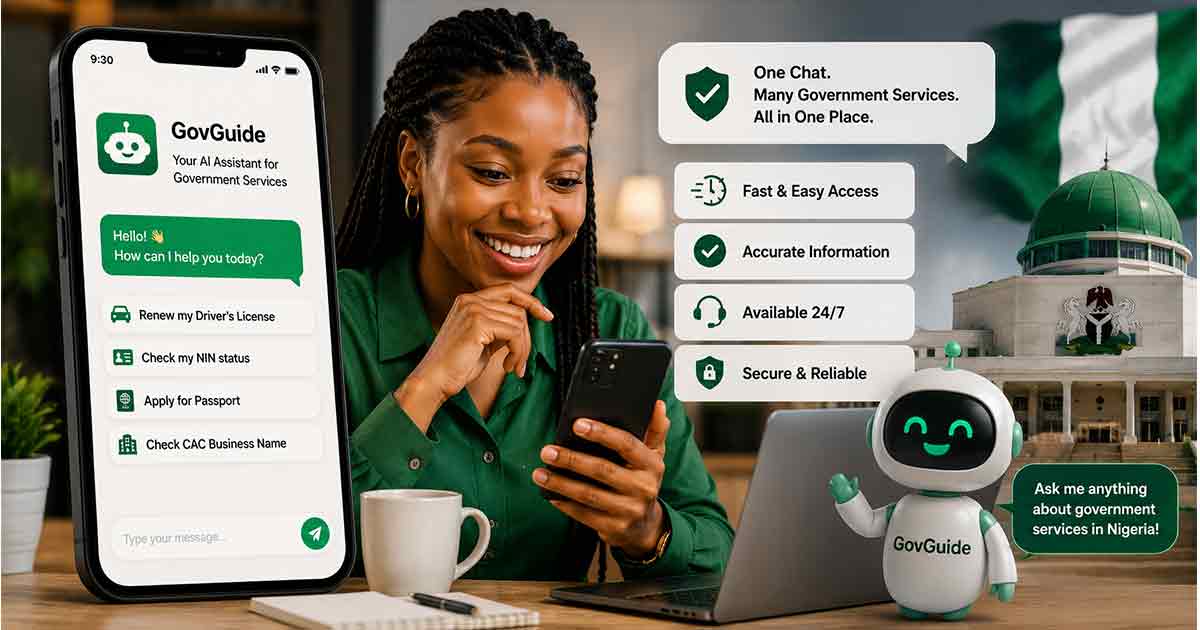
Nigeria Just Launched an AI Chatbot to Help Citizens Navigate Government Services
Getting answers from government agencies in Nigeria has never been easy. Long queues, unresponsive hotlines, and websites that either crash or return outdated information are familiar frustrations for millions of Nigerians. A new tool is trying to change that — and it comes with serious backing from one of the world's largest tech companies.
Nigeria has officially launched GovGuide, an AI-powered chatbot designed to help citizens access government information and services without the usual runaround. Built using Meta's open-source Llama language models, GovGuide is a collaboration between the Nigerian government and some key players in the AI space — and it speaks your language, literally.
What Is GovGuide and Who Built It?
GovGuide is a multilingual AI chatbot developed through a partnership involving Meta, Nigeria's Federal Ministry of Communications, Innovation and Digital Economy (FMCIDE), the National Centre for Artificial Intelligence and Robotics (NCAIR), and Publica AI. The project is part of a broader push to digitize public service delivery and make government information more accessible to ordinary Nigerians.
At its core, GovGuide uses Meta's Llama models — the same open-weight AI architecture powering a growing number of applications globally — to understand and respond to questions about government services. What makes it distinctly Nigerian is its multilingual design: the chatbot supports English, Hausa, Igbo, and Yoruba, four of the country's most widely spoken languages.
The platform is accessible via the web, which means no app download is required to get started. For a country where smartphone storage is often stretched thin by data-heavy apps, that accessibility matters.
What Can GovGuide Actually Do?
The short answer: it helps you find information you'd otherwise spend hours (or days) chasing. GovGuide is designed to address the fragmented nature of Nigeria's public services — a landscape where different agencies maintain separate websites, phone lines, and offices, often with little coordination between them.
Here's the kind of thing GovGuide aims to help with:
- Document and registration queries: Information about obtaining or renewing a National ID (NIN), passport, driver's licence, or birth certificate — including which agency handles what and what documents you need.
- Business registration: Guidance on registering a business with the Corporate Affairs Commission (CAC), understanding tax obligations, and navigating regulatory requirements.
- Education and scholarship programs: Details on government-funded scholarships, JAMB processes, and tertiary education opportunities.
- Health services: Information on public health programs, NHIS coverage, and where to access government healthcare.
- Social welfare: Queries about government assistance programs, poverty alleviation schemes, and agricultural support.
Rather than replacing government portals or offices, GovGuide acts as an intelligent guide — pointing you to the right information and reducing the back-and-forth that usually comes with navigating bureaucracy.
How to Access GovGuide
GovGuide is available through a web-based interface, which means you can access it directly from a browser on your phone, tablet, or computer — no installation needed. The multilingual capability means you can interact with the chatbot in your preferred Nigerian language, which is particularly significant for users who feel more comfortable expressing themselves in Hausa, Igbo, or Yoruba rather than English.
The process is straightforward: visit the platform, type your question in your preferred language, and GovGuide will provide a response based on its training data and the government information it has been built around. The goal is a conversational, back-and-forth experience — not just a static FAQ page.
The Broadband Problem: Who Actually Gets to Use This?
Here's where things get more complicated. GovGuide is a promising tool — but its real-world impact will depend heavily on who can actually reach it.
Nigeria's internet penetration, while growing, remains uneven. Urban centres like Lagos, Abuja, and Port Harcourt have relatively decent connectivity, but rural communities — where many Nigerians live and where government service gaps are most acute — often struggle with unreliable or completely absent internet access.
A chatbot that helps you navigate government services is only as useful as the connection that delivers it. If you're a farmer in rural Kebbi State trying to find out about an agricultural subsidy, or a young person in a border town trying to understand how to register a business, GovGuide's web-only format creates a real access barrier.
Smartphone ownership is also a factor. While feature phone usage is declining and smartphone adoption is rising, there are still significant portions of the population — particularly older Nigerians and those in lower income brackets — who may not have the devices needed to interact comfortably with a web-based AI interface.
These aren't reasons to dismiss GovGuide, but they are limitations that the initiative's stakeholders will need to address if the tool is going to fulfil its stated mission of serving all Nigerians.
Meta's Role and Africa's Broader AI Moment
Meta's involvement in GovGuide isn't incidental. The company has been increasingly active in building AI infrastructure suited for African languages and contexts. Its No Language Left Behind (NLLB-200) model, for instance, supports over 50 African languages — a significant commitment to the continent's linguistic diversity that most Western AI labs have historically ignored.
By contributing the Llama model stack to GovGuide, Meta is positioning itself as a foundational technology partner for Africa's public sector AI ambitions. It also signals that open-weight AI models are becoming the preferred path for governments in emerging markets — providing flexibility, local customisation, and reduced dependency on proprietary vendor lock-in.
For Nigeria specifically, GovGuide fits into a broader digital government agenda that includes the National Digital Economy Policy, NITDA's digital literacy programs, and ongoing efforts to improve the country's ranking in global digital governance indices.
What This Means for Nigerians
If GovGuide works as intended — and that's still a conditional — it could meaningfully reduce the friction between citizens and government services. The frustration of not knowing which agency to call, which form to fill, or which office to visit is something virtually every Nigerian has experienced. A well-trained, multilingual AI that can answer those questions accurately and in plain language would be genuinely useful.
The multilingual support deserves particular attention. Millions of Nigerians are more literate in their mother tongue than in English. Building a government-facing tool that meets people in Hausa, Igbo, or Yoruba isn't just a nice feature — it's a form of inclusion that has been largely absent from Nigeria's digital government efforts until now.
That said, the effectiveness of GovGuide will ultimately hinge on a few things: how frequently the underlying information is updated, how well the chatbot handles edge cases and ambiguous queries, and whether the government commits to maintaining and improving it beyond the initial launch. Many Nigerian digital initiatives have launched with fanfare only to be neglected within months. GovGuide's long-term value will be earned through consistent, reliable performance — not just the press release.
The Verdict
GovGuide is one of the most practically interesting AI launches Nigeria has seen in recent years. It targets a real problem, uses credible technology, and makes a genuine effort at language inclusion. The broadband and device access challenges are real, but they're solvable problems — especially as Nigeria continues to expand its digital infrastructure.
For Nigerians with internet access who have ever spent an afternoon trying to figure out which government agency handles what, GovGuide is worth trying. And for the broader African AI ecosystem, it's a signal that governments are starting to view artificial intelligence not just as a talking point but as a tool for actual public service delivery.
Watch this space — the real test will come in how the platform performs at scale.