Blog
How to Invest in Dollar-Denominated Assets to Protect Your Savings from Naira Inflation
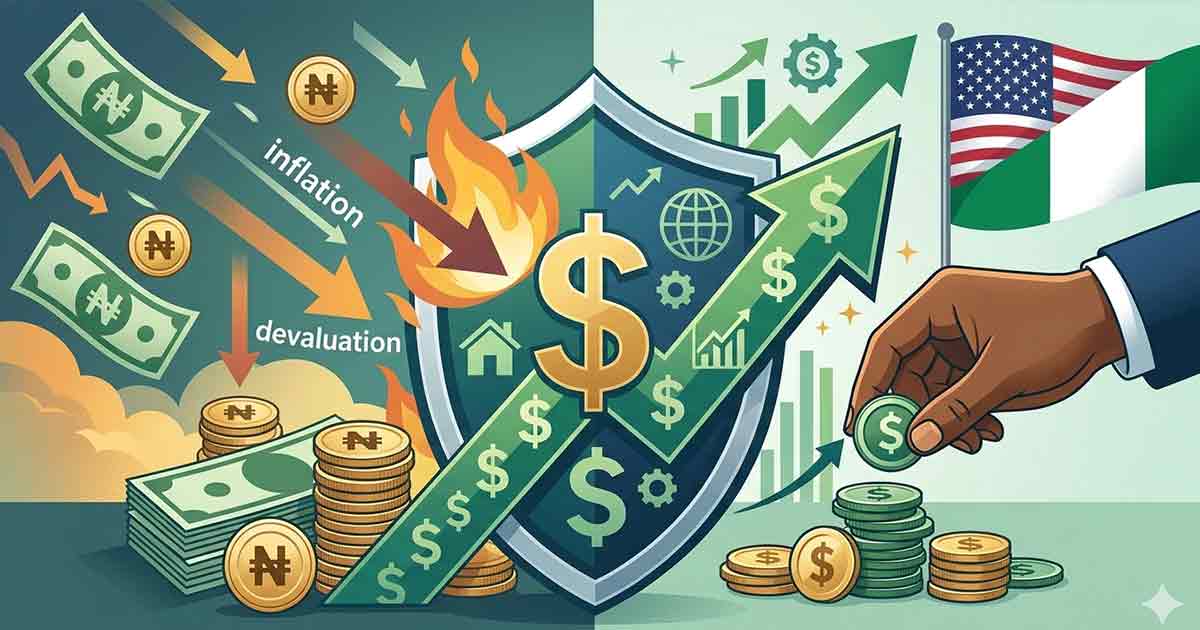
Why Your Naira Savings Are Losing Value Every Day
If you have been keeping your savings in Naira, you have already felt the pain. Nigeria's inflation rate has remained stubbornly high, hovering above 30 percent for much of 2025 and into 2026. The Naira has lost significant purchasing power against the US dollar over the past few years, and the structural weaknesses in Nigeria's economy — from power sector failures to weak export competitiveness — mean this pressure is unlikely to disappear anytime soon.
According to a recent policy brief by the Centre for the Promotion of Private Enterprise (CPPE), while Nigeria recorded a GDP growth of 3.89 percent in Q1 2026, deep structural problems persist. High energy costs, weak manufacturing output, and limited foreign exchange earnings from the non-oil sector continue to put pressure on the Naira. For ordinary Nigerians, this translates to one thing: money kept in Naira savings accounts is quietly shrinking in real value.
The solution many financially savvy Nigerians are turning to is investing in dollar-denominated assets — financial instruments priced and settled in US dollars. This guide breaks down what those assets are, how to access them from Nigeria, and what to watch out for.
What Are Dollar-Denominated Assets?
Dollar-denominated assets are investments that are valued and pay returns in US dollars. When the Naira weakens against the dollar, the Naira value of your dollar-denominated investment automatically increases — even if the underlying asset price stays flat. This is the core of the inflation hedge.
Common dollar-denominated assets accessible to Nigerians include:
- Dollar savings accounts — offered by Nigerian banks and fintech platforms
- US Treasury bonds and bills — government-backed, low-risk dollar instruments
- Dollar-denominated ETFs — exchange-traded funds tracking US or global indices
- Eurobonds — including Nigerian government Eurobonds listed on international exchanges
- Dollar money market funds — offered by some Nigerian asset managers
- Foreign stocks — shares in US or global companies bought through investment platforms
Option 1: Dollar Savings Accounts
The simplest entry point for most Nigerians is a domiciliary account or a dollar savings account. Most major Nigerian banks — GTBank, Access Bank, Zenith Bank, and others — offer domiciliary accounts that hold US dollars. Some fintech platforms like Piggyvest, Cowrywise, and Chipper Cash also offer dollar savings features with competitive interest rates.
The advantage here is simplicity. You convert Naira to dollars at the current exchange rate and hold the dollars. If the Naira depreciates further, your savings are protected in dollar terms. Some platforms even offer interest on dollar balances, though rates are typically lower than Naira savings rates.
What to watch: Exchange rate risk works both ways. If the Naira were to strengthen significantly (unlikely in the near term but possible), your Naira equivalent would fall. Also, watch out for platform fees and withdrawal restrictions.
Option 2: US Treasury Bills and Bonds
US Treasury securities are considered among the safest investments in the world, backed by the full faith and credit of the US government. They pay interest in dollars and return principal in dollars at maturity.
Nigerians can access US Treasuries through international brokerage platforms such as:
- Bamboo — a Nigerian-founded platform that allows Nigerians to invest in US stocks and ETFs, including Treasury-focused funds
- Trove Finance — offers access to US stocks and bonds
- Chaka — another Nigerian platform with access to US markets
- Interactive Brokers — for more sophisticated investors who want direct access to US Treasury auctions
Short-term US Treasury bills (T-bills) with maturities of 3 to 12 months have been yielding around 4 to 5 percent annually in recent years — a meaningful return in dollars, on top of the currency protection benefit.
Option 3: Dollar ETFs and US Index Funds
Exchange-traded funds (ETFs) that track US or global stock indices give you exposure to dollar-denominated equity growth. The S&P 500, for example, has historically delivered average annual returns of around 10 percent in dollar terms over long periods.
Through platforms like Bamboo, Trove, or Chaka, Nigerian investors can buy fractional shares of ETFs like:
- SPY or VOO — tracking the S&P 500
- QQQ — tracking the Nasdaq 100 (tech-heavy)
- BND — a broad US bond market ETF for more conservative investors
These are long-term plays. The stock market can be volatile in the short term, but over 5 to 10 years, dollar-denominated equity ETFs have historically outpaced inflation significantly.
Option 4: Nigerian Eurobonds
The Nigerian federal government and some Nigerian corporates have issued Eurobonds — bonds denominated in US dollars but issued in international capital markets. These pay dollar-denominated interest (coupon) and return principal in dollars at maturity.
Nigerian Eurobonds can be purchased through stockbrokers registered with the Nigerian Exchange Group (NGX) or through international platforms. They offer a way to earn dollar returns while investing in a Nigerian government instrument — a middle ground for investors who want dollar exposure without fully moving assets offshore.
Note: Eurobond prices fluctuate with global interest rate movements and Nigeria's sovereign credit rating. They are not risk-free, but they are a legitimate dollar-denominated option.
Option 5: Dollar Money Market Funds
Some Nigerian asset management companies now offer dollar-denominated money market funds. These pool investor funds and invest in short-term dollar instruments, offering liquidity and modest dollar returns. Platforms like Stanbic IBTC Asset Management and some fintech-linked funds have introduced such products.
These are suitable for investors who want dollar exposure with lower volatility than stocks and more liquidity than bonds.
How Much Should You Allocate to Dollar Assets?
There is no universal answer, but a common framework used by Nigerian financial advisors is the 40/60 or 50/50 split — keeping 40 to 50 percent of investable savings in dollar-denominated assets and the rest in Naira-denominated instruments like Nigerian Treasury Bills, fixed deposits, or real estate.
The right allocation depends on:
- Your income source (if you earn in Naira, dollar assets provide a natural hedge)
- Your investment horizon (longer horizon = more tolerance for equity volatility)
- Your liquidity needs (dollar assets may have withdrawal delays or conversion costs)
- Your risk tolerance
Practical Steps to Get Started
- Open a domiciliary account at your bank or a dollar savings account on a fintech platform.
- Convert a portion of your savings to dollars at the current official or parallel market rate.
- Choose your investment vehicle — savings account for simplicity, T-bills for safety, ETFs for growth.
- Sign up on a regulated investment platform like Bamboo, Trove, or Chaka. Complete KYC verification.
- Fund your account and make your first investment.
- Review quarterly — rebalance as your financial situation or the macro environment changes.
Risks to Keep in Mind
Dollar-denominated investing is not without risks:
- Regulatory risk: The Central Bank of Nigeria (CBN) has historically imposed restrictions on foreign exchange transactions. Policy changes can affect your ability to move money in and out.
- Platform risk: Not all investment platforms are equally regulated. Stick to platforms registered with the Securities and Exchange Commission (SEC) Nigeria or internationally regulated brokers.
- Market risk: US stocks and bonds can fall in value. Dollar ETFs are not guaranteed returns.
- Tax implications: Returns from foreign investments may have tax implications in Nigeria. Consult a tax advisor.
The Bottom Line
With Nigeria's structural economic challenges unlikely to resolve quickly, holding all your savings in Naira is a high-risk strategy. Dollar-denominated assets — from simple dollar savings accounts to US Treasury bills and ETFs — offer a practical, accessible way for Nigerians to preserve purchasing power and build wealth in a currency that holds its value globally.
You do not need to be wealthy to start. Many platforms allow investments from as little as . The key is to start, stay consistent, and diversify across asset types to manage risk.
Your money should work as hard as you do — and in 2026, that means making sure at least part of it is working in dollars.