Blog
How to Spot a Fake Gift Card Buyer in Nigeria Before You Lose Your Card
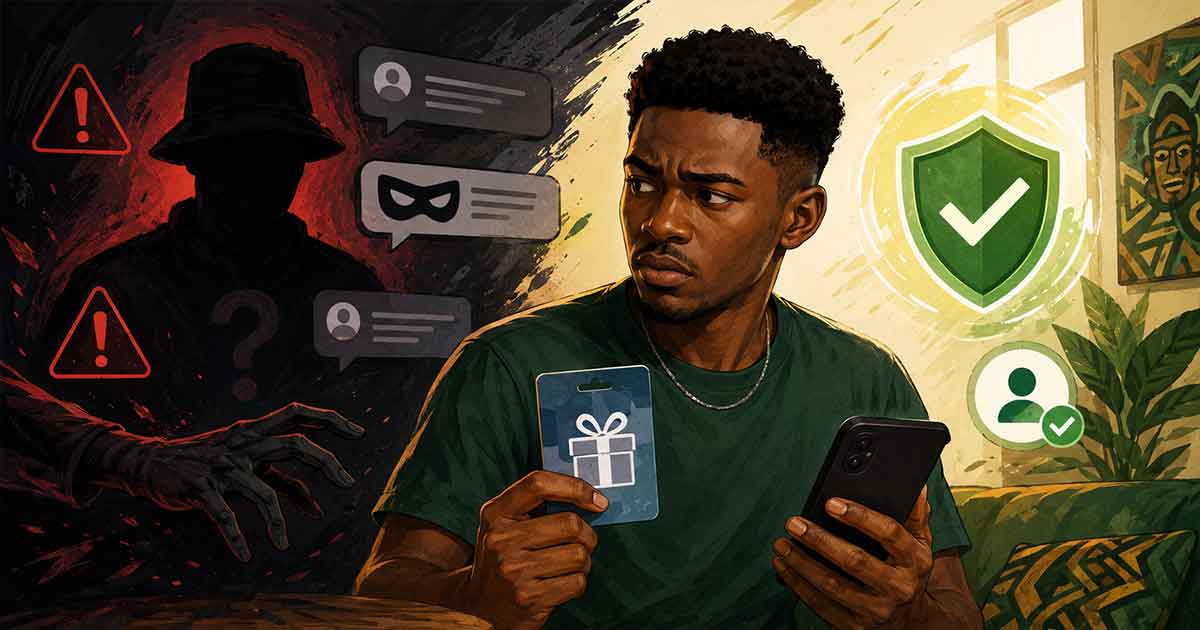
If you sell gift cards in Nigeria, you already know the problem isn't finding a buyer. It's finding a buyer who won't disappear the moment you send the code. The card looks like cash, but the second you paste those 16 digits, you no longer hold the asset. The buyer does. Everything after that depends on whether the person on the other side of WhatsApp is a real trader or a thief in a stock-photo profile picture.
This guide is built for Nigerian sellers who are tired of "trusted vendors" turning out to be ghosts. It walks through the warning signs you can spot in the first three messages, sample conversations you should treat as cancelled, the verification steps that actually filter scammers, and how to weigh peer-to-peer chats against trading platforms.
## Why fake buyers target Nigerian sellers
Nigeria has one of the most active gift card resale markets in the world. Amazon, Steam, iTunes, Google Play and Sephora cards flow through Lagos, Abuja, Port Harcourt and Ibadan every day, mostly traded peer-to-peer on WhatsApp, Telegram, Instagram and X. That liquidity is also what makes the market attractive to scammers. They know:
- New sellers are eager to convert their card to naira fast.
- Many sellers do not have access to escrow.
- Card codes cannot be "unsent" once shared.
- Banks rarely treat a voluntary transfer as fraud.
That asymmetry is the entire scam economy. Your job as a seller is to slow the transaction down just enough for the scammer to give themselves away. They almost always do.
## Red flags you can see in the first three messages
These are the signals that show up before money is even discussed. If you see two or more of them, walk away.
**1. The buyer opens with the rate, not a greeting.**
Real traders confirm card type, denomination, country, receipt status, and whether it's physical or e-code. Scammers skip all of that and lead with "Drop the card, I'll pay immediately."
**2. The rate is significantly higher than market.**
If Amazon USA cash receipt is trading around ₦1,450/$ and a stranger offers ₦1,700/$, that's not generosity. It's bait. Check the live rate on at least two platforms (Cardtonic, Prestmit, Nosh, GCBuying) before you respond.
**3. The profile is too clean or too empty.**
Fresh Telegram account, no display picture, generic English username with random numbers, or a stolen photo of a foreigner holding cash. Real Nigerian traders usually have a Lagos or Abuja location hint, a business name, or visible past activity.
**4. They insist on a specific app or link.**
"Just download this escrow app" or "send via this Telegram bot, it's safer." These are almost always phishing fronts that show a fake "payment pending" screen after you upload the card. The card is gone the moment the image hits their server.
**5. They want the card image, not the code.**
A buyer asking for a clear photo of the card with the code visible is the same as asking for the code itself. Many scams work on the image alone, especially for Steam, iTunes and Razer Gold.
**6. They claim to be paying from abroad.**
"I'm in Dubai, payment will come from my brother's Zenith account." Third-party payments are a classic setup for chargebacks once the original sender reports the transfer as unauthorized. Your bank will reverse the credit; the card is already redeemed.
## Sample conversations that should end the deal
If a chat looks like any of these, close the window.
**Scenario A — The pressure play**
> Buyer: Hi, you get $200 Amazon?
> You: Yes, cash receipt, USA.
> Buyer: Send the code, I'll pay 1,650 immediately.
> You: Can you pay first?
> Buyer: Bro I do this every day, ask anyone. Send first or forget it.
Translation: he has no intention of paying. A real trader will either send first for small amounts, use escrow, or accept a redeemed/verified screenshot before code release.
**Scenario B — The fake proof**
> Buyer: I have sent. See the screenshot.
> *(screenshot of a Kuda or Opay alert)*
> You: I haven't received any alert.
> Buyer: Network. Check in 5 minutes. Meanwhile send the code so I don't waste time.
Bank alerts can be faked with apps that mimic Opay, Kuda, PalmPay and GTBank notifications down to the font. Never act on a screenshot. Only your own bank app or USSD balance counts.
**Scenario C — The redemption trick**
> Buyer: Send the code, I'll redeem and confirm, then pay.
> You: That means you already have my card.
> Buyer: How else will I know it's valid?
The correct answer is a balance check, not redemption. Tools like the official Apple/Amazon balance pages, or a trusted vendor's verification step, confirm value without consuming the card. Anyone who insists on redeeming before paying is taking the card.
## Verification steps that actually work
Use these in order. They take less than ten minutes and remove most of the risk.
1. **Identity check.** Ask for a short voice note in Pidgin or English plus a profile that has been active for more than 30 days. Scammers hate voice. Many will vanish the moment you ask.
2. **Cross-platform check.** Search the WhatsApp number on Truecaller, Nairaland, Twitter/X, and Instagram. A real Lagos-based trader leaves a trail. A fresh number with no footprint is a red flag.
3. **Small test trade.** For new buyers, start with a $25 or $50 card, never $100+. If they refuse small trades, they're not building a relationship; they're hunting a single hit.
4. **Payment first for first-time deals.** Standard practice among Nigerian peer traders is "new buyer pays first, established buyer can negotiate." If they refuse and you're new, that's the entire answer.
5. **Confirm in your bank app, not via SMS or screenshot.** Open the actual bank or fintech app. Refresh the balance manually. SMS and notification banners are the easiest things to fake.
6. **Release the code only after settled funds.** Inter-bank transfers can reverse for up to 24 hours in rare cases. For high-value cards ($300+), wait for the credit to clear or use a known platform.
## When to choose a platform over peer-to-peer
Direct WhatsApp trading offers slightly better rates, but it removes every safety net. Trading platforms exist precisely to absorb the risk you cannot manage alone. For Nigerian sellers, the practical trade-off looks like this:
- **Peer-to-peer (WhatsApp, Telegram):** Best rate, highest risk, zero recourse. Only use with a buyer you've traded with successfully at least three times, and only for amounts you can afford to lose.
- **Established platforms (Cardtonic, Prestmit, Nosh, GCBuying, Tbay):** Slightly lower rate, but the platform holds the risk. They verify codes, settle in naira within minutes, and have a record of your transaction if anything goes wrong.
- **Instagram "vendors" with flashy DMs:** Treat as unknown until proven otherwise. The same red flags above apply, plus the extra risk of disappearing accounts.
If you trade more than ₦500,000 in cards a month, the rate difference between a platform and a peer buyer rarely justifies the loss of even one fake trade. One $200 iTunes card lost to a scammer is roughly ₦300,000 — the equivalent of weeks of peer-trading premium.
## What to do if you already sent the code
First, accept the situation quickly. The longer you argue with the scammer, the more time they have to redeem. Then:
1. **Check the balance immediately.** If the card is partially redeemed, the remaining balance can still be recovered by selling it as a used card at a reduced rate.
2. **Report on the issuing platform.** For Apple, Amazon, Google Play and Steam, customer support can sometimes freeze a card if you report within minutes of redemption. Have the receipt or activation slip ready.
3. **Report the WhatsApp/Telegram account.** Scam reports add up. Even if you don't recover the card, the account may be banned, protecting the next seller.
4. **Save evidence.** Screenshots of the chat, the number, the profile, any payment claim. If the same scammer hits a community group later, your record helps others.
5. **Do not pay "recovery agents".** These are the same scam ecosystem. If anyone in your DMs offers to recover the card for a fee, block them.
## A simple safety rule that filters most scams
If you remember nothing else, remember this: **a real buyer waits, a fake buyer rushes.** Every safety step in this guide works because scammers cannot afford to slow down. They depend on your urgency. The moment you treat every new buyer as unverified until they prove otherwise, you stop being the easy target.
Gift card trading in Nigeria is still one of the fastest ways to convert digital value to naira. It does not have to be one of the riskiest. Set your rules, verify before you release, and walk away from any deal that doesn't survive five minutes of basic checks. The next buyer is always around the corner. Your card is not.